 Tiny Eden
Tiny Eden growth stages
Plants in Tiny Eden move through four main stages: Sprout, Seedling, Mature and Wilting. Early stages need active care — weeding, disease treatment and keeping conditions right. Mature plants are harvested and maintained. Wilting can mean it is time to replace the plant, or it can be used on purpose to attract pollinators.
The four stages
The official FAQ names all four and groups them by what they demand. Sprout and Seedling are the care-intensive phase; Mature is the productive phase; Wilting is the end of the cycle.
Framing them by workload rather than by appearance is useful, because it tells you where your attention actually needs to go across a full apartment of plants.
| Stage | What it needs from you |
|---|---|
| Sprout | Weeding, disease treatment, maintaining conditions |
| Seedling | Weeding, disease treatment, maintaining conditions |
| Mature | Harvest and maintain |
| Wilting | Replace — or keep deliberately to attract pollinators |
Wilting is a choice, not just decay
The most useful detail in the FAQ is that wilting is not purely a failure state. It can signal replacement, but it can also be used for specific purposes like attracting pollinators.
Since some species carry a pollination requirement on their condition panel, letting something wilt on purpose can be a supporting move for the plants around it rather than neglect.
Harvest is where the fork is
At harvest the game asks you to choose between profit and research. Profit feeds the money-and-reputation loop; research unlocks the ability to create new plant varieties.
That makes Mature the decision stage. Everything before it is upkeep, and everything after depends on which branch you took.
Time runs at 60:1
The game clock runs at a 60:1 ratio, so a stage transition takes real minutes rather than being instant. Season also advances, and temperature depends on season, so a long-lived plant experiences changing conditions.
There is no time pressure and no game over. The FAQ says that as long as you take care of your plants you will be fine, and that running out of money is recoverable.
Conditions must hold across the whole cycle
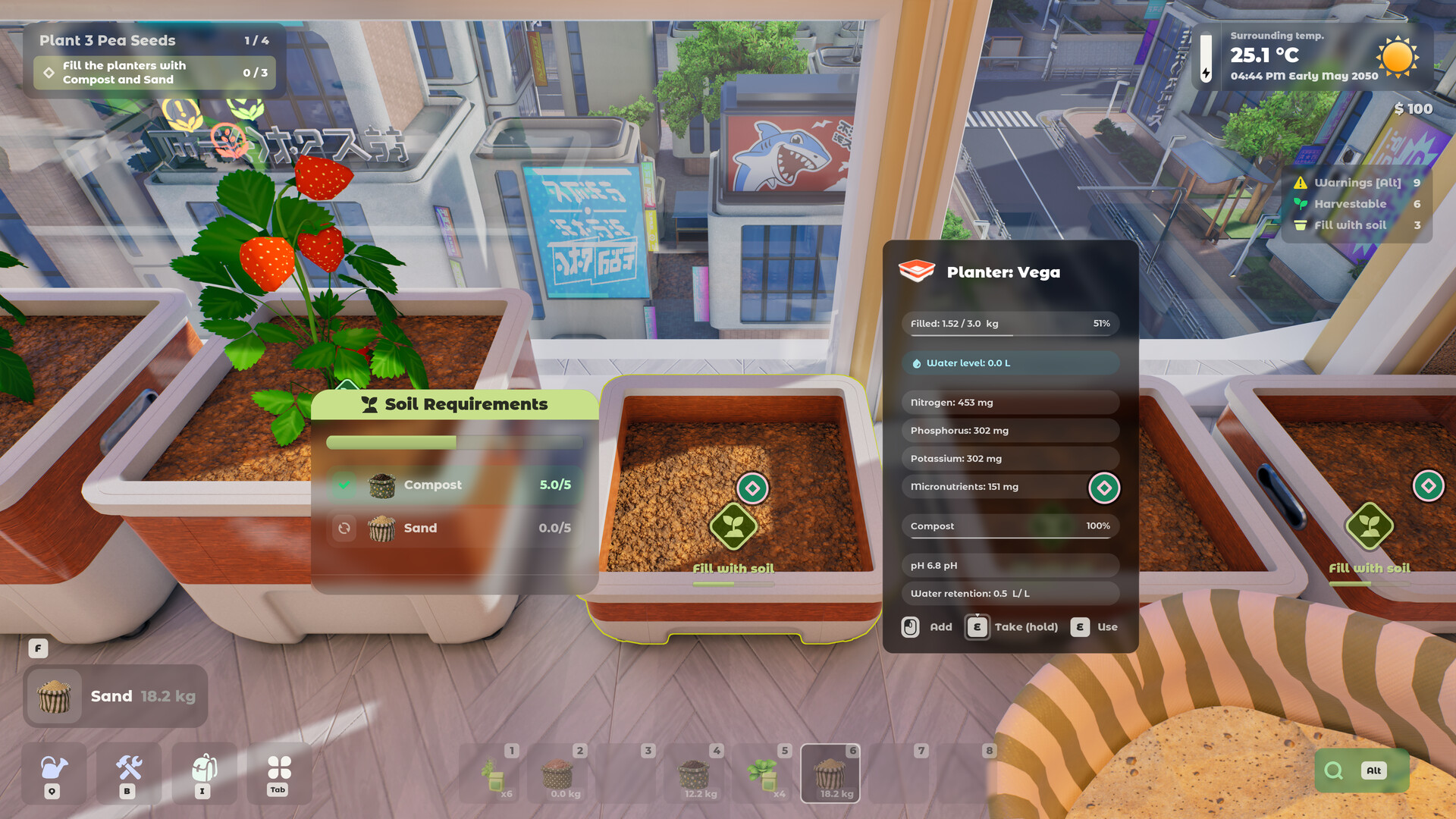
A plant reads planter size, soil type, a temperature band, light, feeder class and pollination throughout its life, not only at planting. Soil in particular drifts, because plants consume nutrients and organic degradation acts on the mix.
That is why a plant can pass its early stages and then struggle later. The position did not change, but the soil it was planted in did.
What the panel shows mid-cycle
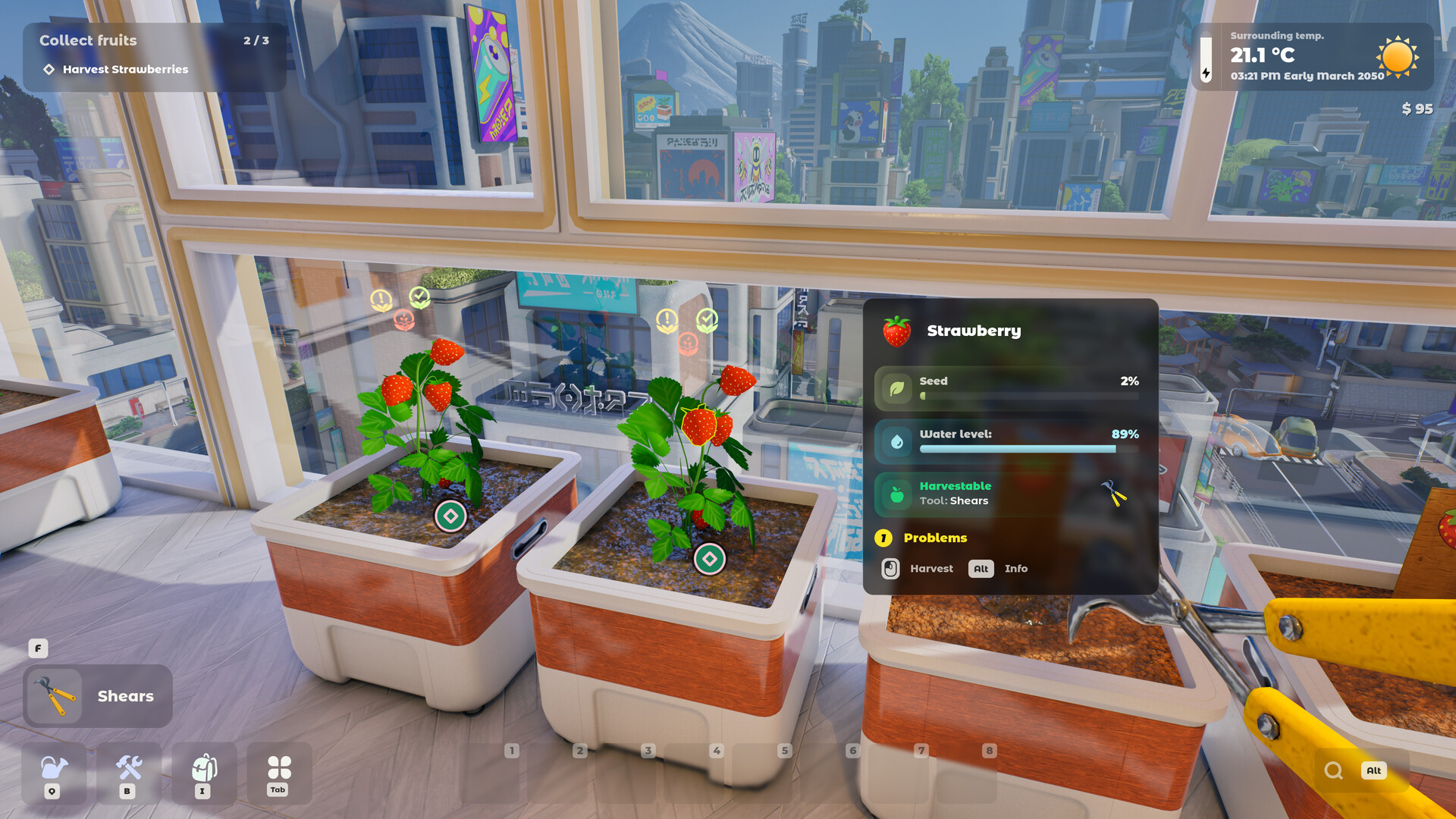
Official screenshots show a live plant tooltip carrying seed progress as a percentage, a water level percentage, whether the plant is currently harvestable and which tool that needs, plus a count of active problems.
In one published shot a strawberry reads seed 2% and water level 89%, marked harvestable with shears as the required tool and one outstanding problem. That is the per-plant view you work from day to day.
Breeding starts at the mature stage
Harvest is where the run branches. Each harvest offers a choice between profit and research, and research is what unlocks the ability to create new plant varieties.
Results are deliberately luck-based. The developers contrast it with real breeding, saying you might get frost-resistant purple tomatoes one run and giant but fragile sour ones the next, and note that varieties can be shared between players.
What splicing does after harvest, and why its button sometimes stays grey, is on the splice page; the choice between profit and research is on the breeding page.
Not confirmed yet
- How long each stage lasts in real time is not published.
- Whether stage duration varies by species is not stated.
Frequently asked
- How many growth stages does Tiny Eden have?
- Four: Sprout, Seedling, Mature and Wilting.
- Should I remove wilting plants?
- Not always. The FAQ says wilting can signal replacement or be used to attract pollinators.
- How fast does time pass?
- At a 60:1 ratio, per the official FAQ.
Sources
Every fact here is drawn from the official sources above. Points the developers have not confirmed are marked as not confirmed rather than guessed.